Medieval seal with a 2,000-year-old Roman gemstone is discovered in England


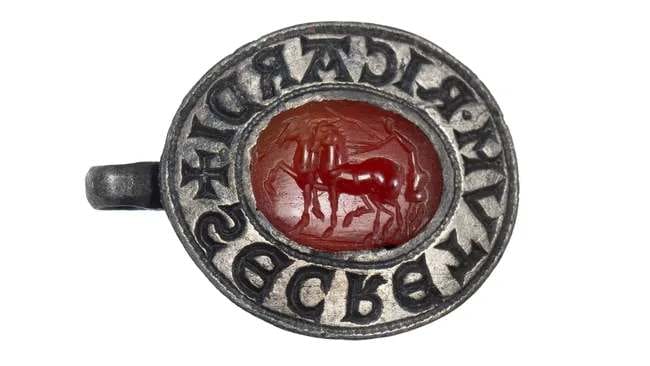
A metal detectorist found a medieval seal described by experts as “truly special” because it contains at its center a Roman gemstone carved around two thousand years ago. The discovery was made in Gosfield, north of Braintree, in the county of Essex, England, in September 2024, and was recently reported by the BBC.
The artifact was analyzed by specialists from the Portable Antiquities Scheme and declared a treasure after an official investigation conducted by a coroner. According to Lori Rogerson, the Finds Liaison Officer for Essex, it is uncommon to find an object that brings together elements from two such distinct historical periods.
The seal, made of medieval silver, measures about 2.7 centimeters in length and weighs approximately 6.4 grams. Unlike traditional signet rings, it has a loop at one end, indicating that it was likely worn suspended, perhaps as a pendant.
At the center of the piece is an oval, dark red gemstone made of carnelian, engraved with the image of a two-horse chariot driven by a charioteer — a scene typical of races held in the circuses of Ancient Rome. Experts date this engraving to the late 1st century BC or early 1st century AD, making it at least 1,200 years older than the medieval silver setting.
Around the seal’s bezel is a mirrored inscription that reads “+SECRETVM.RICARDI,” a Latin phrase that can be translated as “The secret of Richard” or “Richard’s secret seal.” A Christian symbol in the form of a cross pattée also appears, widely used in the Middle Ages, including by orders such as the Knights Templar.
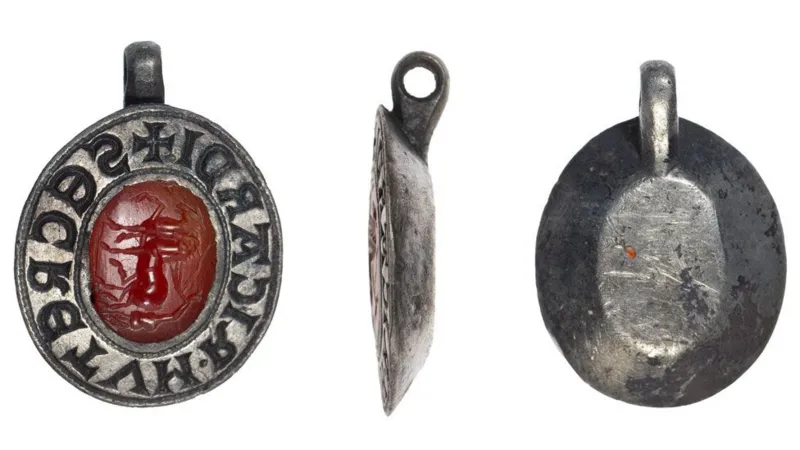
According to Rogerson, the seal was made specifically for a man named Richard, who used it to mark letters and documents in hot wax. The deliberate choice of an ancient Roman gemstone may have been a way to demonstrate knowledge of the classical world and, at the same time, social status.
“It was definitely a marker of prestige,” Rogerson explained in an interview with the BBC. “It showed that the owner had the means to obtain something from a very distant time and place — or at least wanted to be seen as someone important.”
Although some gemstones of this type were imported from Italy between the 11th and 13th centuries, others of lower quality may have been found by medieval peasants during agricultural work in Britain.
Because it is made of silver and is more than 300 years old, the seal falls under the provisions of the Treasure Act of 1996. After the inquest is concluded, the Braintree Museum in Essex hopes to have priority in acquiring the piece for public display.
Additional details at: finds.org.uk