Scientists Identify the World’s Oldest Rock Art in an Indonesian Cave


Scientists have identified what may be the oldest rock art ever known in the world: a hand stencil at least 67,800 years old, found in a cave in the southeastern part of the island of Sulawesi, Indonesia. The discovery was published this Wednesday (21) in the scientific journal Nature.
In addition to setting a new chronological record for prehistoric art, the find represents the oldest archaeological evidence of the presence of modern humans (Homo sapiens) on the islands located between the Asian and Australian continents.
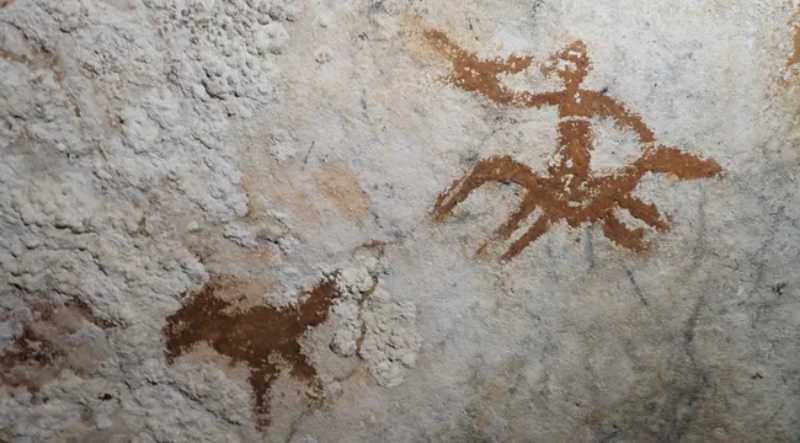
The hand stencil is surrounded by other, more recent rock paintings, including another similar stencil, indicating that the cave was used as a symbolic space for tens of thousands of years.
According to the researchers, the discovery helps fill an important gap in our understanding of the migration route of the ancestors of Indigenous Australian peoples, who arrived on the continent at least 60,000 years ago.
“It is very likely that the people who produced these paintings in Sulawesi were part of the population that later spread across the region and eventually reached Australia,” said archaeologist Adhi Agus Oktaviana, lead author of the study and a researcher at Indonesia’s National Research and Innovation Agency.
Although the original meaning of the art is unknown, the hand stencils suggest the existence of relatively large groups with their own cultural identity.
“If you know that cave and recognize that art, you are part of that group, of that culture,” explained Maxime Aubert, co-author of the study and an archaeologist at Griffith University in Australia.
Before this discovery, the oldest known rock art was a hand stencil dating to about 66,700 years ago, found in Spain and attributed to Neanderthals. However, the dating technique used for that find is still the subject of debate among specialists.
In Sulawesi, the new stencil is about 1,100 years older. The image measures approximately 14 by 10 centimeters and, although heavily worn by time, still shows visible fingers and palm. One detail stands out: the fingers were intentionally narrowed, an artistic technique known only from this region.
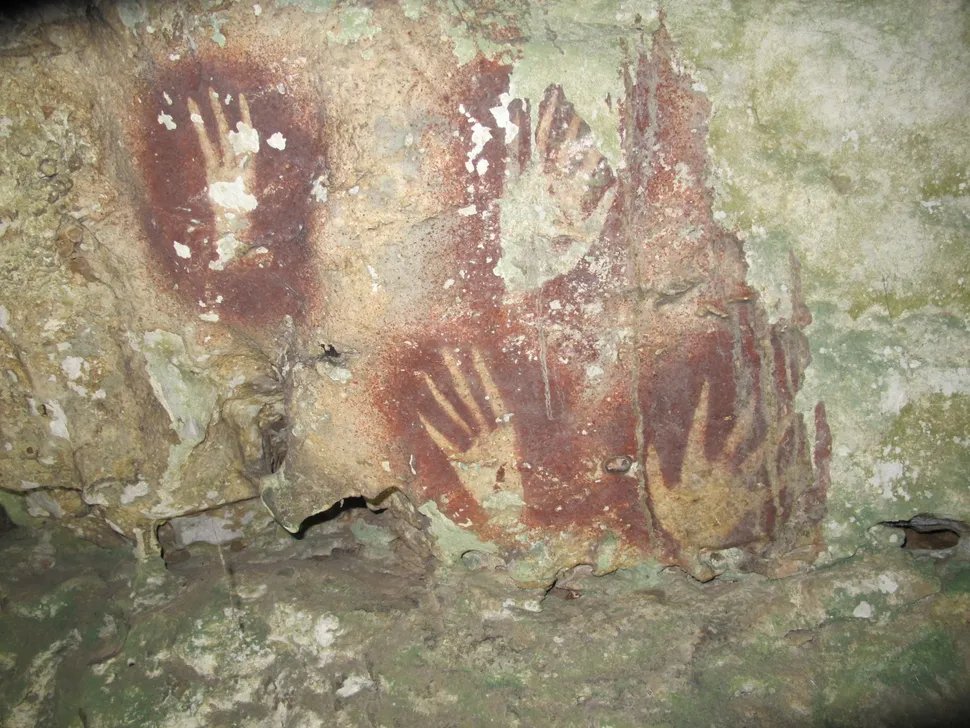
Just 11 centimeters to the left of the oldest stencil, researchers identified another one, made with darker pigment and dated to up to 32,800 years ago, demonstrating that the cave was used as an artistic “canvas” for at least 35,000 consecutive years.
The paintings were covered by small mineral formations of calcium carbonate, known as “cave popcorn.” Because these deposits form after the creation of the art, dating them provides a minimum age for the images. In some cases, it was also possible to determine maximum ages when the pigment lay on top of these minerals.
Although other human species inhabited Sulawesi in the past, the researchers state that the technical complexity of the stencils indicates they were made by Homo sapiens, who were already living in the region at that time.
The stencils were likely created by blowing pigment directly onto the hand using the mouth. This method raises an intriguing possibility: extracting human DNA directly from the art.
“We may have the genetic signature of the people who made this. That would be extraordinary,” said Aubert.
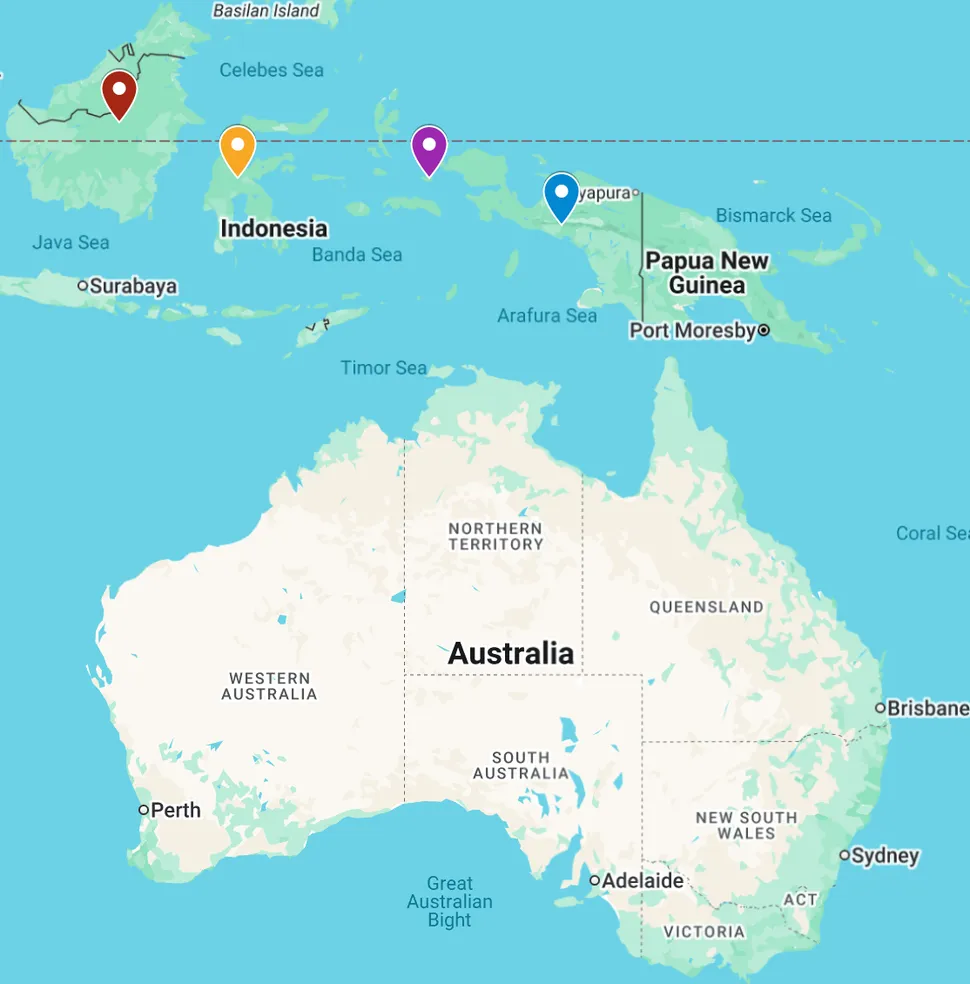
The study reinforces the hypothesis that modern humans reached Australia by sailing along a northern route, departing from what is now the island of Borneo, passing through Sulawesi, and continuing to Western New Guinea or the Indonesian island of Misool.
For archaeologist Chris Clarkson, also of Griffith University, who was not involved in the research, the discovery is impressive.
“What surprises me most is that these works are located exactly along a migratory route toward Australia,” he said. “This shows that the earliest peoples who crossed Southeast Asia were not merely surviving — they were creating art, crossing oceans, and maintaining complex symbolic traditions.”
More information: Oktaviana, A. A., Joannes-Boyau, R., Hakim, B., et al. Rock art from at least 67,800 years ago in Sulawesi. Nature (2026). https://doi.org/10.1038/s41586-025-09968-y