New sauropodomorph dinosaur genus discovered in China


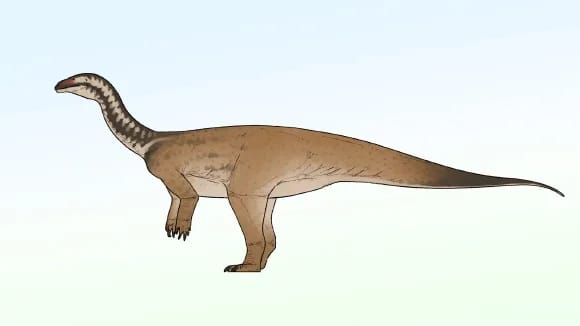
A new genus and species of sauropodomorph dinosaur has been identified from a partial skeleton found in southwestern China. Named Xiangyunloong fengming, this dinosaur lived during the Early Jurassic period, approximately 190 million years ago, and represents an important link between early herbivorous dinosaurs and the giant sauropods that dominated the Mesozoic world.
Identification of Xiangyunloong fengming
Xiangyunloong fengming is a member of the massopodan group, which includes sauropodomorph dinosaurs that lived on Earth from the Late Triassic to the Late Cretaceous. The specimen discovered is approximately 9 to 10 meters long, making it one of the largest known primitive sauropodomorphs in China. The skeleton was unearthed in the Fengjiahe Formation, in Luming City, Yunnan Province.
Anatomical Features and Evolution
Analysis of the partial skeleton reveals an unusual anatomical combination. Contrary to the expectation of a long neck, Xiangyunloong fengming had a robust and elongated tail, which may have functioned as a counterbalance, allowing the animal to rear up on its hind legs to feed. This feature suggests an alternative evolutionary pathway among early sauropodomorphs leading toward more advanced sauropods.
Importance of the Discovery for Paleontology
The discovery of Xiangyunloong fengming significantly enriches knowledge of Early Jurassic dinosaur fauna in southwestern China. Researchers state that the new anatomical data obtained from the specimen are essential for understanding morphological diversity and evolutionary patterns among primitive sauropodomorphs, which played a crucial role in the evolution of sauropods.
Publication of Research Results
The research findings were published on March 25 in the journal Royal Society Open Science. The study, authored by Shao-Bin Hu and colleagues, presents a detailed analysis of the new dinosaur and its implications for paleontology, contributing to a better understanding of sauropod origins. The results can be accessed in the official publication.
The identification of Xiangyunloong fengming represents a significant advance in understanding dinosaur evolution, highlighting the importance of paleontological discoveries in reconstructing the history of life on Earth.
Source: sci.news