Identified 50 Possible Maya Markets in Mexico


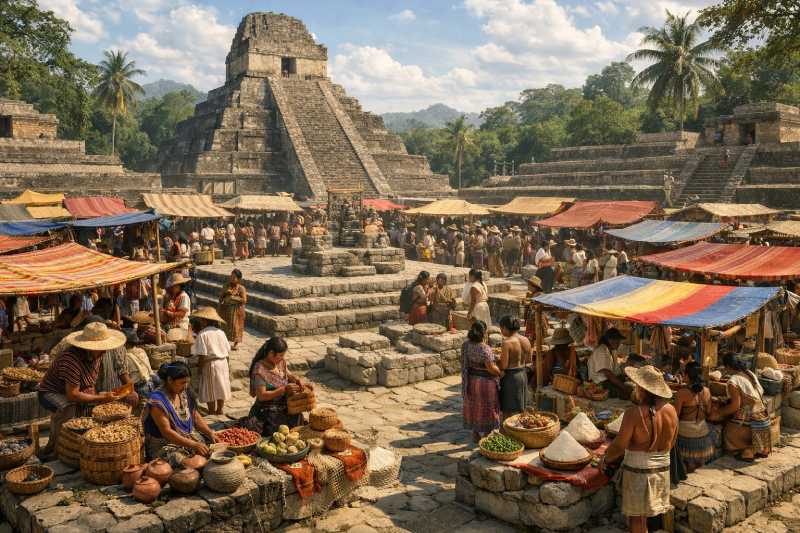
Recent research conducted by archaeologist Ivan Šprajc, from the Research Center of the Slovenian Academy of Sciences and Arts, has uncovered dozens of unusual architectural complexes in the central and western Maya Lowlands — structures that may represent some of the strongest evidence ever found of marketplaces built during the Classic Maya period. Identified primarily in the Mexican state of Campeche, these groupings form distinctive concentric patterns that challenge traditional interpretations of this civilization’s economic organization.
What are the “nested structures” and how were they discovered
The newly identified complexes consist of low, narrow, elongated platforms arranged in roughly concentric circles or rectangles. At first glance, they appear unassuming — modest mounds lost in dense tropical vegetation. But their spatial pattern is anything but random.
The identification of these sites relied heavily on LiDAR technology (airborne laser scanning), which is capable of revealing architectural structures hidden beneath vegetation cover. Using data from NASA G-LiHT and field campaigns carried out between 2016 and 2023 by the National Center for Airborne Laser Mapping (NCALM), Šprajc identified 50 nested structures distributed from west to east across the Maya Lowlands — and acknowledges that many more are almost certainly still waiting to be discovered.

Similarities to known marketplaces: Tikal and Calakmul
What makes these findings especially significant is their resemblance to two sites already interpreted as marketplaces: the East Plaza of Tikal, in Guatemala, and the Chiik Nahb complex at Calakmul, Mexico.
Tikal’s East Plaza is made up of long, narrow buildings with rows of closely spaced doorways, no interior benches, and none of the partitions typical of residential spaces — a configuration that, according to researcher Christopher Jones, could hardly have served any function other than a marketplace. At Calakmul, murals found in substructure 1-4 of the Chiik Nahb complex depict figures handling food, textiles, ceramics, and other goods. The accompanying hieroglyphic inscriptions identify them not by personal names, but by the commodities they carry — a linguistic practice that, in modern Ch’orti’ Maya, designates precisely who sells a given product at the market.
The newly catalogued nested structures share the same dimensions, architectural grammar, and spatial logic as these two reference sites, considerably strengthening the hypothesis that they also functioned as marketplaces.
Features pointing to a commercial function
Beyond their formal resemblance, the complexes share other attributes frequently associated with marketplaces in Mesoamerican archaeological literature. The low platforms likely supported stalls made of perishable materials for displaying goods, while the intermediate spaces served as circulation corridors. The limited openings along the perimeter of the complexes suggest that access was controlled — possibly to collect fees from both vendors and buyers.
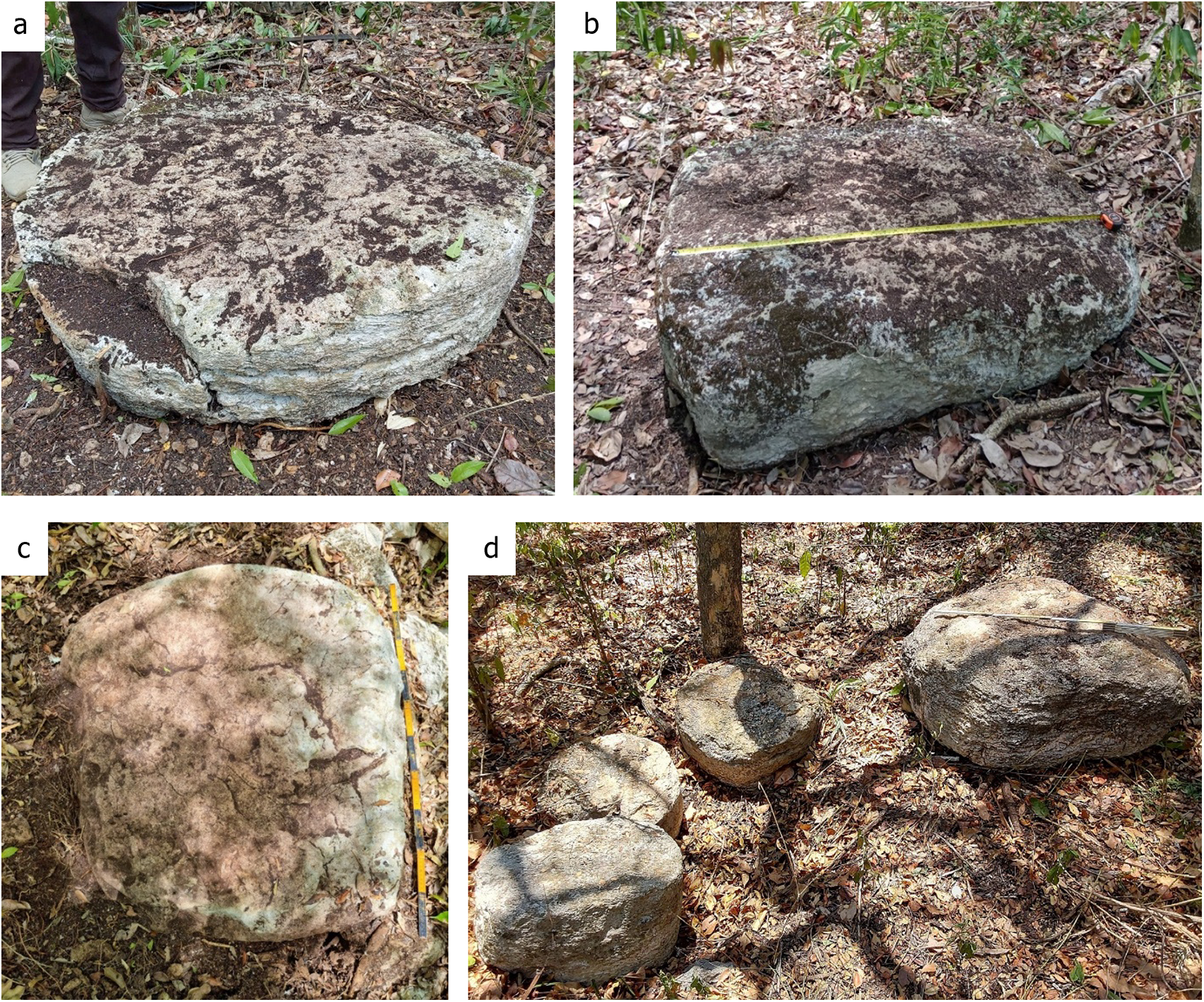
Several complexes include at least one larger structure, which may have served as a warehouse or the headquarters of a supervisory authority, along with annexed patios with restricted access. The presence of stone altars and traces of shrines within the groupings links commerce to ritual practices — something well documented in the Mesoamerican context, where marketplaces were simultaneously economic, social, and sacred spaces. In at least 13 of the identified complexes, ballcourts were found in the immediate vicinity.
Geographic distribution and trade routes
The distribution of the complexes is not random. Many are situated in major urban centers — such as Ocomtún, Calakmul, Tikal, Yaxhá, and El Palmar — or in smaller residential clusters interconnected by causeways. The high density observed in central and western Campeche is particularly striking: a single 121 km² zone scanned by LiDAR revealed 15 occurrences.
Šprajc proposes that this concentration may reflect regional economic specializations shaped by the environment. The Chactún area, for instance, features extensive agricultural terraces and wetland canals — while neighboring regions, with rocky and poorly fertile soil, lack such landscape modifications. Communities less suited to cultivation would have depended more heavily on redistribution networks to obtain food and other resources, which would justify the creation of a denser market infrastructure. The proximity of eight complexes to the La Rigueña River — one of the few perennial waterways in the region — and the possible presence of a dam for large-scale fishing suggest that fish may have been among the goods traded locally.
Chronology and field evidence
Chronological data obtained at Tikal and Calakmul indicate that these complexes were not built before the Classic period (ca. 250–900 AD). Test excavations conducted by Šprajc’s team in Campeche confirm occupation primarily during the Classic period, although Late Preclassic material was also recovered at the Chacbitún complex, suggesting that some may have earlier origins.
The absence of stucco floors in the internal spaces — consistently observed across the inspected complexes — is interpreted as evidence favoring a marketplace function: packed-earth floors would have better absorbed rain and liquids spilled during exchanges. Animal bone fragments, flint cores, and projectile points found during excavations are consistent with food consumption and craft production activities — secondary uses well documented in Mesoamerican marketplaces.
A more complex picture of Maya trade
For decades, archaeologists have debated whether the ancient Maya relied on centralized redistribution systems — controlled by elites — or on decentralized marketplace exchanges. The nested structures suggest that the reality was more dynamic and sophisticated than either model alone.
Šprajc considers it likely that markets operated at multiple simultaneous levels: complexes located in centers with monumental architecture may have been geared toward long-distance trade supervised by elites, while those embedded in smaller communities served local exchange and surplus redistribution. The high concentration of complexes near one another also suggests that some may have specialized in specific types of goods or operated on different days in rotation — much like the modern tianguis of Mexico.
The discovery reframes the image of Maya civilization: not merely a society oriented toward monumental architecture and ritual, but also a civilization deeply engaged in organized, everyday economic exchange. As new LiDAR data becomes available and systematic excavations advance, these understated and barely visible structures promise to reveal even more about economic life in the Maya Lowlands.
Source: Šprajc, Ivan (2026). “Nested Constructions in the Yucatán Lowlands: Ancient Maya Marketplaces?” Ancient Mesoamerica, 1–20. https://doi.org/10.1017/S0956536126100923