The Oldest Jaw Surgery in the World


Russian scientists have identified surprising evidence of a sophisticated surgical procedure performed about 2,500 years ago on a woman belonging to the ancient nomadic Pazyryk culture in southern Siberia. The discovery was made after a detailed analysis of the woman’s skull using computed tomography, revealing that she survived a severe jaw injury thanks to a surgical intervention unprecedented for the time.
The research was conducted by specialists from Novosibirsk State University (NSU) in Russia. The results indicate that ancient physicians performed a kind of “primitive prosthesis” on the jaw joint, allowing the patient to regain the ability to speak and eat.
The skull belongs to a woman who lived approximately between the 6th and 3rd centuries BCE, a period associated with the Pazyryk culture, part of the Scythian-Siberian world of the Iron Age. The analysis was made possible thanks to the use of high-resolution computed tomography.

According to researcher Vladimir Kanygin, head of the university’s Laboratory of Nuclear and Innovative Medicine, the technology made it possible to “virtually remove” the mummified soft tissues that had been preventing the study of the bone structure.
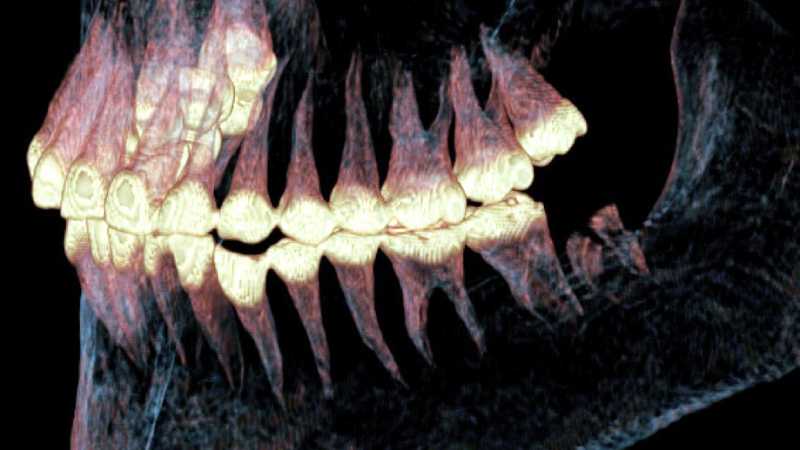
“The CT scan worked like a true time machine. It allowed us to examine the skull without damaging it and create an extremely accurate three-dimensional digital model,” the scientist explained.
Based on 551 tomographic slices, the researchers digitally reconstructed the skull and identified clear signs of trauma and surgical intervention.
The images revealed that the woman suffered a violent impact on the right side of the skull, which depressed the temporal bone by between 6 and 8 millimeters. The blow destroyed the right temporomandibular joint — responsible for the movements of the jaw.
This injury would have made it impossible to speak or chew food. Under normal conditions in antiquity, this would likely have led to death from starvation or infection.
But the examination revealed something unexpected.
The researchers found two small channels drilled into the bone, each about 1.5 millimeters in diameter. One of them passed through the head of the mandible and the other through the zygomatic process of the temporal bone.
These channels met at a right angle, forming a planned structure.
Inside the holes, remnants of elastic material were detected — probably animal tendon or horsehair — which functioned as a kind of surgical ligature.
Radiologist Andrey Letyagin explained that this material kept the joint stabilized:
“This primitive prosthesis kept the articular surfaces together and allowed the patient to move her jaw.”
Although the woman likely still felt pain and may not have been able to chew on the injured side, the procedure was enough to save her life.
One of the most impressive pieces of evidence from the study is that the bones around the holes healed. The CT scan showed a ring of bone tissue formed around the drilled channels, a clear sign that the surgery took place while the woman was still alive.
In addition, the teeth on the left side of the jaw were extremely worn, indicating that she chewed for a long time using only that side after the operation.
This suggests that the patient lived for months or even years after the surgery.

The remains were discovered in 1994 at an archaeological cemetery called Verkh-Kaljin-2, located on the remote Ukok Plateau in the Altai Mountains, in what is now the Altai Republic of Russia.
The excavation was conducted by archaeologist Vyacheslav Molodin.
The site belongs to the so-called Pazyryk Culture, known for its tombs frozen in permafrost that preserve organic artifacts, clothing, wooden objects, and even mummies.
The woman was found in a wooden larch sarcophagus, lying on her side in a position similar to someone sleeping.
Curiously, the tomb contained no grave goods — something unusual for this culture — except for a wig typical of those worn by Pazyryk women.
For the researchers, the discovery demonstrates that the Pazyryk people possessed surprisingly advanced medical knowledge.
According to archaeologist Natalia Polosmak, who participated in the study, these people already performed cranial trepanations and had a deep understanding of human anatomy.
She believes that the cultural practice of mummification may have helped develop these medical skills, since it required detailed manipulation of the human body.
The Pazyryk were also extremely skilled craftsmen. Their leather garments were sewn with up to 20 stitches per centimeter using fine threads made from animal tendons — a level of manual precision comparable to that required for delicate surgical procedures.
Scientists do not know exactly how the woman suffered the injury, but they suggest several hypotheses:
- a fall from a horse at high speed
- a fall from a great height
- a violent impact during everyday activities
Horses were central to Pazyryk life, which makes accidents of this kind relatively plausible.
Although it is only a single case, the find provides new evidence that nomadic societies of antiquity possessed more sophisticated medical technologies than previously believed.
Rather than the traditional image of barbarian warriors, the Pazyryk are increasingly appearing as a complex society, with artists, craftsmen, and even skilled surgeons.
The analysis of the skull shows that for that young woman, about 25 to 30 years old, the medical ingenuity of her people literally made the difference between life and death.