Study Reveals Expansion of Habitable Zones Around Low-Mass Stars


Researchers have been working to better understand habitable zones around low-mass stars, such as K-type and M-type stars. These stars, smaller and cooler than the Sun, have characteristics that may influence the potential for life on exoplanets. A recent study proposes a new definition of habitable zones, taking into account stellar activity and its implications for astrobiology.
Definition of Habitable Zones Around Low-Mass Stars
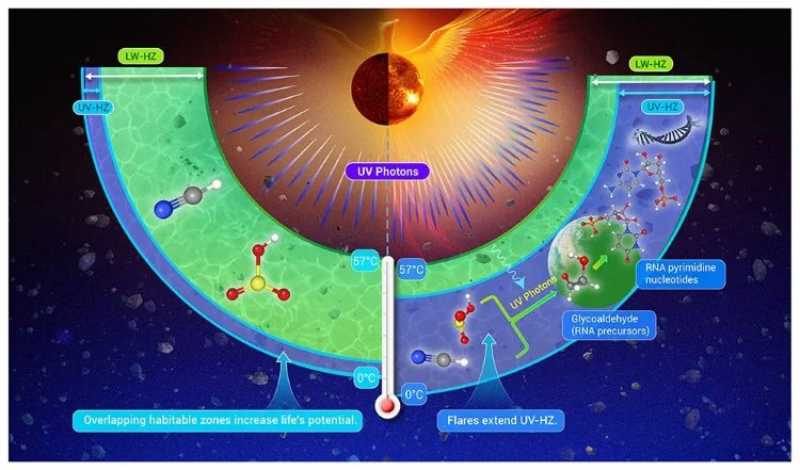
Habitable zones are regions around a star where conditions may allow the presence of liquid water, essential for life as we know it. In the case of low-mass stars, such as K-type and M-type stars, these zones are significantly smaller compared to the habitable zones of stars like the Sun. The study in question introduces a new approach to the ultraviolet habitable zone (UV-HZ), which considers UV radiation as a crucial factor for potential habitability.
Impact of Stellar Activity on Habitable Zones
Stellar activity, especially in low-mass stars, can alter conditions within habitable zones. The study analyzed how stellar flares can expand the ultraviolet habitable zone, increasing the chances that life could develop on exoplanets. The research used models to evaluate the synthesis of RNA precursors—fundamental for the formation of life—at different distances from the star.
Research Findings on Exoplanets
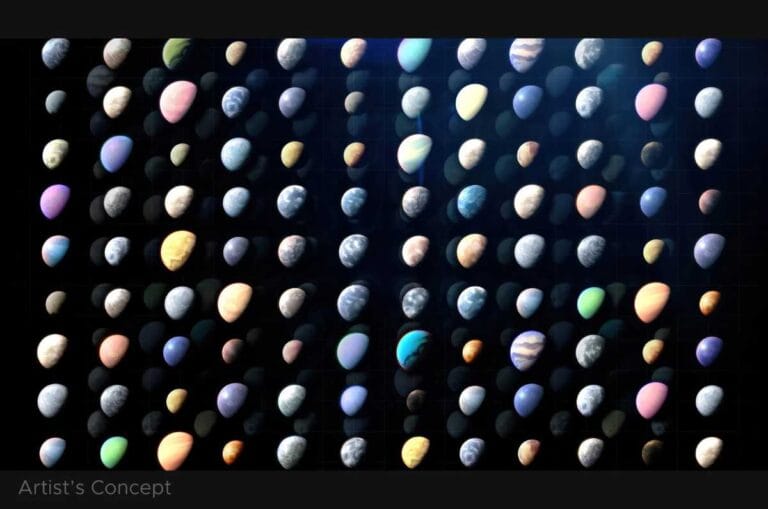
The researchers applied their models to nine confirmed exoplanets orbiting K-type and M-type stars. Among them, only three were identified as lying within the overlap of the ultraviolet and liquid-water habitable zones. The results indicate that, despite the possibility of such overlap, the habitability of many of these planets still requires further investigation.
Future Perspectives in the Search for Extraterrestrial Life
The search for life on exoplanets continues to be a field of intense research. Stars such as TRAPPIST-1, which hosts seven rocky worlds, exemplify the potential for habitability in low-mass systems. However, stellar activity and the possibility that planets are tidally locked to their stars raise questions about their true habitability. The future of astrobiology will depend on new observations and models that can clarify these dynamics.
The study of habitable zones around low-mass stars reveals new dimensions in the search for extraterrestrial life. Understanding the interactions between stellar activity and planetary conditions is essential for advancing this field. Continued research may provide valuable insights into habitability in other solar systems.
Source: universetoday.com