New telescope images uncover ‘Green Monster’ in Cassiopeia A
Byomniletters.com
Using NASA's James Webb Space Telescope, astronomers uncovered a mysterious feature within the remnant, nicknamed the "Green Monster," alongside a puzzling network of ejecta filaments forming a web of oxygen-rich material. When combined with X-rays from NASA's Chandra X-ray Observatory, the data helped astronomers shed light on the origin of the Green Monster and revealed new insights into the explosion that created Cas A about 340 years ago, from Earth's perspective.
Cassiopeia A (Cas A) is a supernova remnant located about 11,000 light-years from Earth in the constellation Cassiopeia. It spans approximately 10 light-years. Credit: X-ray: NASA/CXC/SAO, NASA/JPL/Caltech/NuStar; Optical: NASA/STScI/HST; IR: NASA/STScI/JWST, NASA/JPL/CalTech/SST; Image Processing: NASA/CXC/SAO/J. Schmidt, N. Wolk, and K. Arcand
Like with the Cygnus Loop, Chandra has provided a 3-dimensional (3D) printable model that can be used to explore the end stage of a star’s life. These 3D models are based on state-of-the-art theoretical models, computational algorithms, and observations from space-based telescopes like Chandra that give us accurate pictures of these cosmic objects and how they evolve over time.
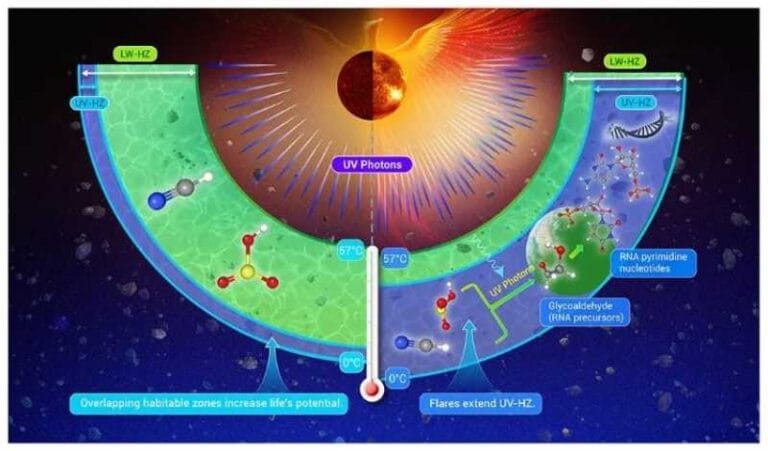
Study reveals new definitions for habitable zones around low-mass stars and their implications for astrobiology. Graphical illustration depicting the liquid water habitable zone (LW-HZ) and the ultraviolet habitable zone (UV-HZ) exmained in this…
Startup Claims It Can Convert Water into Rocket Fuel and Plans Orbital Test in 2026 Aboard SpaceX’s Falcon 9. Image credit: SpaceX An American startup led by veteran aerospace engineers is drawing attention…
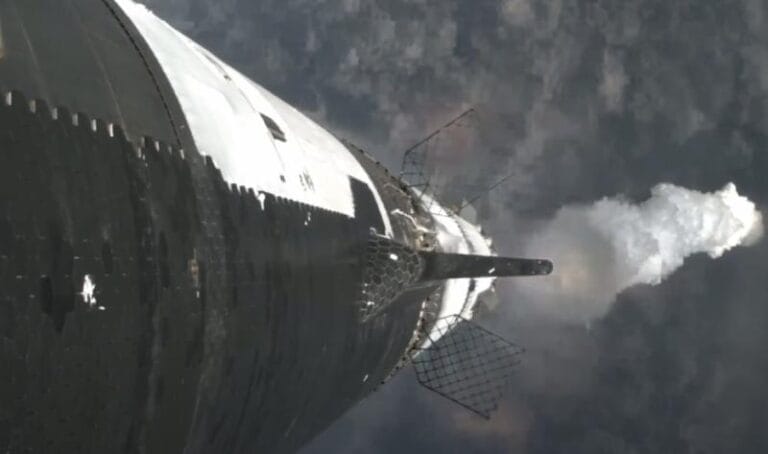
Elon Musk wants to take artificial intelligence to space with solar-powered orbital data centers. An artist's conception shows a Starship upper stage deploying a satellite in orbit. (SpaceX Illustration) Elon Musk, CEO of…
A study of feldspar crystals in ancient Australian rocks reveals new clues about Earth’s primordial mantle and the origin of the Moon. A study of feldspar crystals found in Australia’s oldest magmatic rocks…
It is a quasi-moon that will share Earth's orbit for the next 60 years. A new study has confirmed its existence. The newly discovered quasi-moon 2025 PN7 shares an Earth-like orbit. But from…